
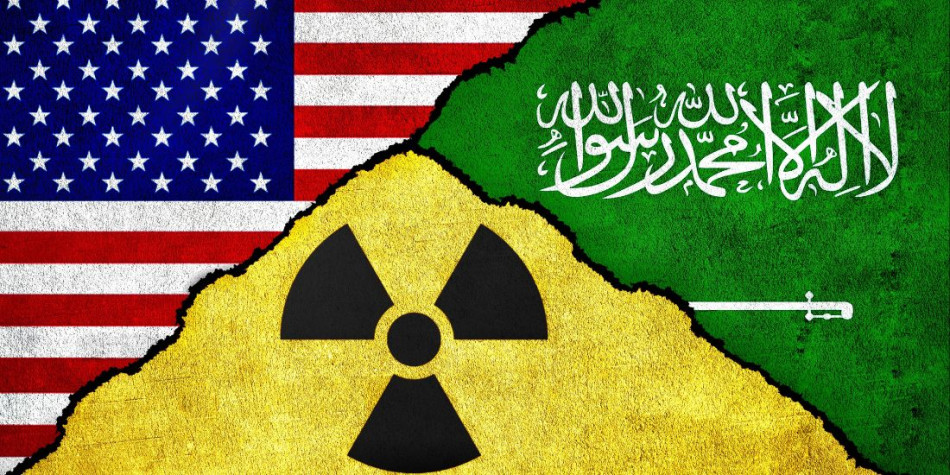
The war that began on 28 February has transformed the Iranian nuclear threat in Saudi strategic thinking from a hypothetical scenario into a concrete, long-term security challenge, reinforcing Riyadh’s view of nuclear capabilities as an instrument of strategic balancing and national security.
The Iran War and Saudi Arabia’s Nuclear Future

The Middle East’s nuclear order has long rested on three unequal pillars. The first is Israel’s policy of nuclear opacity: a weapons capability that the country neither formally acknowledges nor denies, but whose existence is widely accepted. The second is Iran’s indigenous nuclear fuel-cycle programme, whose history of undeclared activities placed it at the centre of a prolonged non-proliferation crisis and, ultimately, war. The third comprises the region’s compliant non-nuclear states, which depend heavily on foreign technology and imported nuclear fuel and operate under more restrictive non-proliferation arrangements.
The twelve-day conflict of June 2025 and the wider U.S.–Israel–Iran war that began on 28 February 2026 disrupted the Iranian pillar of this order, at least temporarily. The U.S.–Saudi nuclear agreement signed on 22 July may prove consequential in a different way: by redrawing the technological and political boundaries that have traditionally defined the third category.
Signed in Washington by U.S. Energy Secretary Chris Wright and Saudi Energy Minister Abdulaziz bin Salman, the 30-year accord is an agreement for peaceful nuclear cooperation concluded under Section 123 of the U.S. Atomic Energy Act. Such agreements do not themselves provide for the construction of nuclear reactors or automatically authorize individual transfers. Rather, they establish the legal framework necessary for significant U.S. nuclear cooperation, including the transfer of nuclear materials and equipment, while facilitating technical exchanges, scientific research, and safeguards cooperation. As the U.S. Department of Energy describes it, a 123 Agreement provides the legal basis for such cooperation to proceed, subject to applicable licensing and non-proliferation requirements.
Before entering into force, the agreement must undergo a 90-day period of congressional review. The document signed on 22 July therefore represents the opening of a pathway through which Riyadh could gain access to U.S. nuclear technology rather than the immediate commencement of nuclear cooperation. Its implementation will depend on congressional scrutiny, subsequent licensing decisions, and the negotiation of arrangements governing individual projects and transfers.
A further layer of uncertainty emerged only a day after the signing, when President Donald Trump linked nuclear cooperation to Saudi Arabia's normalization of relations with Israel. Riyadh, meanwhile, continues to insist that recognition of Israel must be preceded by a credible political process leading toward Palestinian statehood. The gap between these positions leaves considerable uncertainty over when, or indeed whether, the agreement will become operational.
Since the full text has yet to be published, debate has centred on the provisions disclosed thus far. Available information indicates that the agreement neither imposes an explicit and permanent prohibition on uranium enrichment within Saudi Arabia nor grants Riyadh an immediate or unconditional right to enrich. Instead, a two-year joint assessment is expected to determine whether domestic enrichment can be justified on technical and economic grounds. Should the assessment prove favourable, the parties could consider a “black-box” arrangement designed to prevent Saudi personnel from gaining access to sensitive nuclear technology.
The proposed formula seeks to separate the physical location of an enrichment facility from control over the technology it contains. An enrichment plant could therefore operate on Saudi territory without necessarily placing its most proliferation-sensitive components or technical knowledge under unrestricted Saudi control. While such a distinction may be workable in technical terms, its non-proliferation credibility will ultimately depend on details that remain undisclosed. These include ownership and operational authority, restrictions on personnel access, permissible enrichment levels, limits on stockpiles, monitoring and verification procedures, and control over emergency shutdown decisions.
Until these questions are resolved, the black-box model cannot in itself be regarded as a sufficient non-proliferation safeguard. More importantly, even a tightly controlled enrichment facility would carry considerable political significance. By accepting the principle that enrichment could take place on Saudi territory, Washington would establish a precedent that other regional states might invoke in seeking comparable treatment.In this respect, the agreement represents a departure from the “gold standard” established by the United Arab Emirates in 2009, when Abu Dhabi formally renounced domestic uranium enrichment and spent-fuel reprocessing.
Saudi Arabia’s continued reluctance to adopt the International Atomic Energy Agency’s Additional Protocol introduces a further layer of concern. Although a bilateral U.S.–Saudi assurance mechanism could strengthen oversight of facilities established under the agreement, it could not replicate the Additional Protocol’s broader verification mandate, particularly its provisions for detecting undeclared nuclear activities and providing access to associated undeclared locations. The more consequential question, therefore, is not whether declared joint facilities can be adequately monitored, but whether Saudi Arabia’s nuclear programme, as a whole, will be subject to a sufficiently comprehensive and intrusive verification regime.
Saudi Arabia’s Nuclear Ambitions and the Iran War
Saudi Arabia’s nuclear ambitions long predate the latest war. Since the beginning of 2000s, Riyadh’s pursuit of nuclear technology has evolved into a systematic strategy rooted in three interrelated objectives: advancing economic development, addressing security concerns and securing greater technological autonomy. Saudi Arabia began exploring national options more seriously in 2009 and progressively built the necessary institutional foundations through the establishment of the King Abdullah City for Atomic and Renewable Energy, the launch of the Saudi National Atomic Energy Project in 2017, and the creation of a dedicated nuclear energy company in 2022.
Although Saudi Arabia began discussions with Washington over a possible 123 Agreement in 2012, persistent technical and political obstacles prevented the two sides from reaching an accord for more than a decade. Riyadh resisted permanently renouncing enrichment and reprocessing while remaining reluctant to adopt the Additional Protocol. In Washington, these positions generated concerns that a civilian nuclear programme could eventually provide the technological foundations for a latent weapons capability. Mohammed bin Salman’s 2018 declaration that Saudi Arabia would pursue nuclear weapons if Iran acquired them further reinforced such concerns. The murder of Jamal Khashoggi later that year further eroded congressional confidence in the Saudi leadership and made the transfer of sensitive nuclear technology politically more difficult to defend.
During the Biden administration, efforts to embed nuclear cooperation within a broader regional bargain further complicated the negotiations. Washington tied progress on the nuclear file to Saudi–Israeli normalisation, US security guarantees and wider strategic cooperation. Although Mohammed bin Salman’s remarks in 2023 suggested that the parties had made considerable progress towards such an arrangement, the attacks of 7 October and Israel’s subsequent military campaign in Gaza fundamentally altered the political landscape, making normalisation untenable for Riyadh in the near term. Nuclear negotiations consequently became entangled with disputes over proliferation, human rights, congressional oversight, mutual confidence, and the unresolved Palestinian question.
The second Trump administration initially appeared more inclined to disentangle civilian nuclear cooperation from these broader regional issues and pursue it as a strategic and economic objective in its own right. As Trump returned to the White House, mounting tensions over Iran’s nuclear programme and the growing risk of an Iran–Israel confrontation pushed human-rights concerns and, temporarily, Saudi–Israeli normalization further down Washington’s agenda. At the same time, the economic and geopolitical value of integrating Saudi Arabia into the U.S.-led nuclear ecosystem became increasingly apparent.
The agreement was not a product of the war. The war did, however, transform the strategic environment in which the remaining obstacles were assessed. By increasing the costs of further delay and strengthening Riyadh’s bargaining position, the conflict provided the additional impetus needed to move a mature but long-stalled process toward formal signature.
What Did the War Change?
The war accelerated U.S.–Saudi nuclear cooperation by intensifying two related security concerns. First, Iran’s conventional missile and drone capabilities demonstrated its capacity to transmit the costs of war across the region. Tehran showed that it could threaten maritime traffic through the Strait of Hormuz and Bab el-Mandeb, arteries central to Saudi energy exports and economic security, while placing U.S. bases and civilian infrastructure in the Gulf at risk. The conflict also exposed the practical limits of the U.S. security commitment. Washington remained indispensable to Gulf defence, but it could neither insulate its partners completely from Iranian retaliation nor guarantee the uninterrupted operation of regional trade routes. This gap between the breadth of U.S. commitments and the protection it could deliver encouraged Riyadh to reassess its security and deterrence policy.
Second, beyond the threat posed by Iran’s conventional and asymmetric capabilities, repeated attacks on its nuclear facilities may have far-reaching consequences for Tehran’s nuclear policy. They could strengthen the argument within Iran that only a nuclear deterrent can prevent future coercion or regime-threatening intervention. From Riyadh’s perspective, therefore, the greater danger lies not in Iran’s immediate post-war capabilities, but in the possibility that Tehran will rebuild its nuclear programme with greater political resolve and an explicit deterrent purpose. In this regard, the war that began on 28 February has transformed the Iranian nuclear threat in Saudi strategic thinking from a hypothetical scenario into a concrete, long-term security challenge, reinforcing Riyadh’s view of nuclear capabilities as an instrument of strategic balancing and national security.
The same developments increased the urgency of the agreement for Washington. The inability of the United States to shield its Gulf partners fully from Iranian retaliation weakened confidence in its role as the region’s ultimate security guarantor. Civil nuclear cooperation offered one means of restoring that confidence while embedding the U.S.–Saudi relationship in a longer-term technological and institutional framework.
Washington also faced a strategic choice over the programme’s external orientation. Saudi Arabia was unlikely to abandon its nuclear plans simply because the United States withheld cooperation. Refusing an agreement could instead have pushed Riyadh towards Chinese or Russian suppliers, reducing U.S. leverage over technological standards, fuel-cycle choices, and verification arrangements. From Washington’s perspective, a Saudi programme built around U.S. technology and regulatory practices may therefore represent the more manageable option, even if the concessions required to secure that outcome carry proliferation risks of their own.
The agreement consequently serves several objectives at once: it opens a potentially lucrative market for American companies, limits opportunities for Chinese and Russian nuclear influence, and seeks to keep Saudi Arabia strategically and technologically anchored to the United States. Whether it ultimately emerges as a pragmatic framework for managing proliferation risks under U.S. oversight or as a precedent legitimizing the pursuit of nuclear-threshold capabilities in the Middle East will depend on how it is implemented.